2023 GDAMS : Stop spending on military that threatens peace and the Earth!

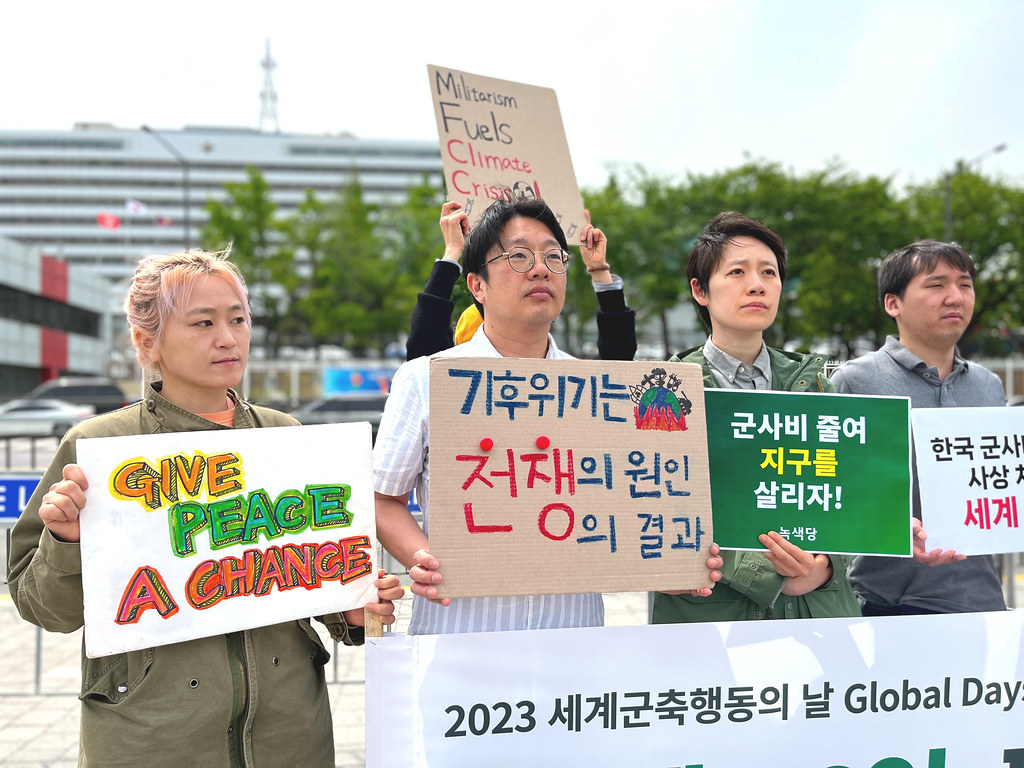
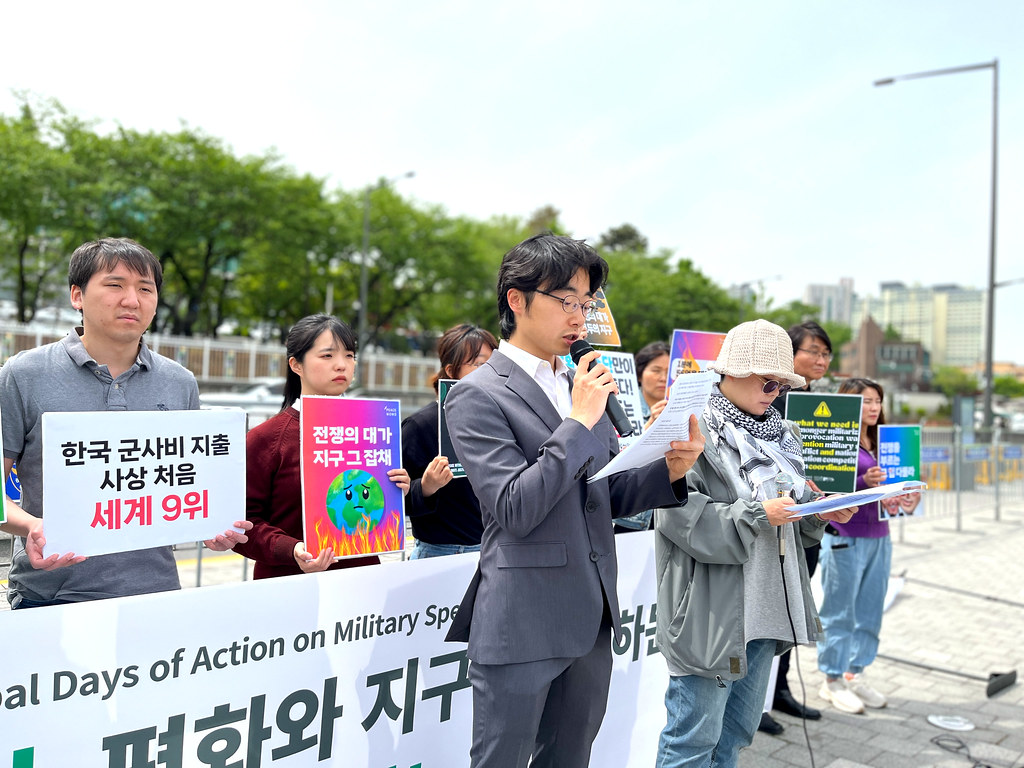

2023 Global Days of Action on Military Spending (GDAMS) Statement
₩5.6 billion [$4 million] a minute,
Stop spending on military that threatens peace and the Earth!
“I believe that K-Defense will contribute to ‘world peace through strength’ beyond Korea,” said Defense Minister Lee Jong-sup in a meeting with defense company CEOs on April 17. Last year, South Korea earned a record $17.3 billion from defense exports. A report on the defense market by the Korea Institute of Industrial Economics and Trade says the changes brought about by the Russia-Ukraine War are the “chance of a lifetime” for emerging arms exporters like South Korea. According to the United Nations Office of the High Commissioner for Human Rights (OHCHR), civilian casualties in Ukraine have reached at least 21,300 over the past year, while Ukrainian and Russian military casualties have exceeded 100,000. The war has created nearly eight million refugees, more than 90 percent of whom are women and children. The idea of cashing in on the war-fueled boom – or rather, the “business of selling death” – shows “world peace through strength” just as it is.
The phrase “peace through strength” always emphasizes deterrence. Strong weapons are always followed by stronger weapons from the other side. President Yoon Suk-yeol has been calling for a preemptive strike against North Korea and the strengthening of South Korea’s Three-Axis defense system since he was a candidate. On April 13, North Korea test-fired a solid-fuel ballistic missile, which is difficult to detect in advance and be countered by the Three-Axis defense system, which is supposed to catch the launch and strike first. When THAAD was deployed in South Korea, China further expanded its missile system with the introduction of the Dongfeng missiles. Strength begets more strength. More strength begets even more strength. “Peace by strength” will only fuel this arms race and never bring peace to either side.
Those who say that peace requires a different approach to coexistence, such as dialogue and cooperation rather than deterrence, are often labeled idealistic or unaware of reality. As the concept of the “main enemy,” revived after five years, shows, “peace by strength” always emphasizes the enemy. It is said that great strength is necessary to defeat the enemy, and that casualties when that strength is exercised are also inevitable. But what is really inevitable? Last month, as the largest South Korean-U.S. military exercises in five years got underway, North Korea responded with test launches of ballistic and cruise missiles. In response to North Korea’s test launch of a solid-fuel missile, the United States and South Korea launched missile defense drills, and on the same day, Russia and China responded with large-scale exercises. When South Korean President Yoon Suk-yeol said on April 19 that South Korea could provide military support to Ukraine if there was a mass attack on civilians, a Kremlin spokesman hinted at possible retaliation, saying that such support would be considered intervention in the war. Power-to-power confrontations escalate crises endlessly. This is the reality we have to face now, a crisis that would not be surprising if war broke out at any moment.
Global crises are no longer evitable. The phrase “War Costs Us the Earth,” the slogan of this year’s Global Day of Action on Military Spending international campaign, shows that human wars are clearly responsible for the global climate crisis. If the carbon footprint of the global military sector is calculated as if it were a country, it is about 5.5% of the global carbon footprint, ranking fourth behind China, the United States and India. According to the Trends in World Military Expenditure 2022, released today by the Stockholm International Peace Research Institute (SIPRI), military spending around the world reached $2.24 trillion last year, up 3.7% year-on-year. On the other hand, the Green Climate Fund, which industrialized countries pool to help developing countries reduce carbon emissions and combat climate change, has only $98.7 billion in pledges for 2022.
Military spending and arms races that feed on war only accelerate war crises and the global climate crisis. The price spikes and food and energy crises that followed the Russia-Ukraine War have taken a toll on the world. Even in this situation, countries have rushed to increase their defense spending. South Korea’s military spending in 2022 ranked ninth in the world, its first single-digit ranking in a decade. In 2023, South Korea’s defense spending will reach 57 trillion won, up 4.4% from the previous year. The global arms acquisition budget also increased significantly following the Russia-Ukraine War. The “2023-2027 National Defense Medium-Term Plan” released by the South Korean Ministry of National Defense plans to spend a total of 331 trillion won on defense from 2023 to 2027, of which 107 trillion won will be spent on arms acquisition, an average annual increase of about 10.5%.
It is time to prioritize scarce budgets and resources to address the climate crisis, reduce social inequality, and build peace, not on military spending. While military spending is on the rise, the budget for reducing carbon emissions is woefully inadequate. The South Korean military has been found to emit more carbon than all the other public agencies in the country combined, yet it is not subject to public sector greenhouse gas reduction targets. Even under the United Nations Framework Convention on Climate Change, the military is not required to report emissions statistics. According to South Korea’s 2023 Sustainable Development Goals (SDGs) progress report, South Korea has the lowest share of renewable energy among OECD countries and ranks fourth in greenhouse gas emissions per gross domestic product (GDP). Forests over twice the size of Seoul have been lost and the biodiversity index has declined. Income inequality between classes ranks 11th among OECD countries and the relative poverty rate ranks 8th, and continues to worsen. Workplace fatalities are also up from last year. Inter-Korean relations have taken a turn for the worst this year, the 70th anniversary of the armistice. Yet non-military measures such as reconciliation and trust are nowhere to be found in the government’s policy toward North Korea, and there is talk of nuclear weapons, let alone denuclearization of the peninsula.
Real crises that threaten lives and daily lives are the unavoidable reality we face. It is no longer acceptable to increase military spending in the name of stronger security.
On the Global Day of Action on Military Spending 2023, we demand the following:
Let’s use our resources to address real crises that threaten lives and daily lives, not on military spending. Let’s redirect military spending to address climate change, build social safety nets, and prevent disasters.
Let’s stop the arms race that exacerbates crises and create peace through peaceful means. Let’s work to improve relations through phased disarmament and resumption of dialogue, not more weapons and military exercises that destroy trust.
24 April 2023
강정평화네트워크, 금정굴인권평화재단, 기독청년아카데미, 기후위기기독인연대, 난민인권센터, 남북평화재단, 남양주여성회, 녹색당, 대안문화연대, 성남여성회, 여성평화운동네트워크, 열린군대를위한시민연대, 용인여성회, 이천여성회, 일본군성노예제문제해결을위한정의기억연대, (재)성프란치스코평화센터, 전북녹색연합, 전쟁없는세상, 정치하는엄마들, 제주평화인권센터, 참여연대, 청년기후긴급행동, 팔레스타인평화연대, 평등교육실현을 위한 대전학부모회, 평택평화센터, 평화네트워크, 평화를만드는여성회, 평화바닥, 피스모모, 한국기독교교회협의회 화해통일위원회, 한국여성단체연합, 한국YMCA전국연맹, 한베평화재단, KIN(지구촌동포연대) (총 35개 단체)
>> Click Here to see Korean version

정부지원금 0%, 회원의 회비로 운영됩니다
참여연대 후원/회원가입